
News
2027: Obi-Kwankwaso bid faces Northern resistance

Published
4 months agoon
By
Admin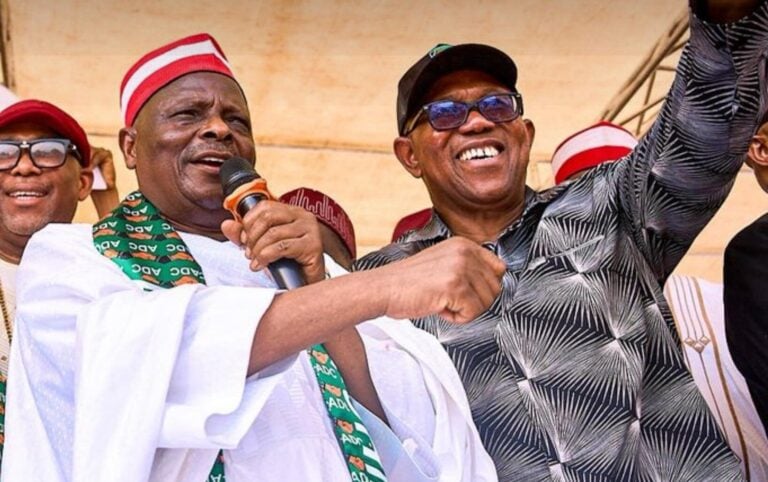
2027: Obi-Kwankwaso bid faces Northern resistance
The presidential ambition of former Anambra State governor, Peter Obi, is facing serious resistance from some northern political stakeholders and sections of the electorate, findings by Sunday PUNCH have revealed.
Some of the stakeholders, who spoke with our correspondents, disclosed that “majority of northerners” had yet to embrace his party, the Nigeria Democratic Congress.
It was also gathered that some northern leaders had started warning their followers against the party, while portraying Obi and his running mate, Rabiu Kwankwaso, as anti-northern interests.
In one of the political materials being circulated across some WhatsApp platforms in the region, Obi and Kwankwaso were projected as “haram” (forbidden).
On Tuesday, there were reports that some angry youths in Ungogo Local Government Area of Kano State burnt Obi and Kwankwaso’s campaign posters.
Similarly, a member of the Kano State House of Assembly, Muhammad Tomas, who recently joined the NDC from the All Progressives Congress, returned to the APC.
‘NDC is unknown’
Speaking with one of our correspondents on Saturday, the National Publicity Secretary of the Arewa Consultative Forum, Prof. Tukur Muhammad-Baba, said the NDC had yet to gain significant visibility and acceptance among northern voters.
He said the party remained “largely unknown” to ordinary voters across the region.
Muhammad-Baba said while some prominent opposition figures continued to attract media attention, their political influence in the North was far from certain.
He particularly cited Kwankwaso, whose support base, according to him, may no longer be as solid as it appeared during the 2023 presidential election.
“There is even doubt about whether Kwankwaso can still hold on to Kano, where he recorded his most impressive performance in the last election. Apart from Kano, his influence in many parts of the North remains uncertain,” Muhammad-Baba stated.
The ACF spokesman noted that many politicians associated with the party had moved across several political platforms over the years, creating confusion among voters.
Muhammad-Baba further argued that many northerners had become disillusioned with politics built around ethnic, regional, and religious sentiments.
“The average northerner is tired of being told that having a northern candidate or a Muslim-Muslim ticket is the solution to Nigeria’s problems. People are becoming more careful because previous expectations have not produced the desired results,” he said.
According to him, political elites and voters are increasingly scrutinising the past statements and actions of opposition leaders and raising questions about their consistency and credibility.
He said many were beginning to question political alliances and ideological shifts among politicians who previously criticised one another but had now become allies.
Such developments, he said, were making voters more cautious in their political choices.
“The average northern elite is asking: where do we go from here? There is confusion and uncertainty. It is not necessarily because people dislike the NDC. The party is simply not well known,” he said.
The ACF spokesman said the growing frustration among citizens was not directed at one political party alone but reflected broader dissatisfaction with the political class.
“In my opinion, the average northern voter is tired of all the political parties without exception. People are no longer impressed by slogans and promises. They want practical solutions to their problems,” Muhammad-Baba added.
Obi’s alleged sympathy for IPOB
Similarly, the President of the Arewa Youth Consultative Council, Zaid Ayuba, said the NDC was not being accepted in the North because of Obi, whom he said northerners did not trust.
He dismissed Kwankwaso’s influence and ability to market him, noting that Obi’s “open support for the Indigenous People of Biafra” was an albatross.
“Obi and Kwankwaso are known in the North, just like Tinubu and Atiku are known. But politics is different from victory. Obi and Kwankwaso are not accepted in the North in a way that would make one think they will win the 2027 election. In fact, they cannot come close to that.
“A stigma has been trailing Obi’s candidature before his declaration in 2023. He can never be accepted in the North because of two factors. One is that he has openly shown that he is an IPOB sympathiser. Obi had, in several interviews, tried to condemn the Supreme Court judgment on the proscription of IPOB and its designation as a terrorist organisation.
“There are people from other parts of this country who try to make northerners look as if they are terrorist sympathisers. But that is not true. No reasonable northerner or authority came out to sympathise with Boko Haram leaders like Muhammad Yusuf or Shekau,” he said.
According to Ayuba, unless Obi gives a reasonable and convincing explanation of his stance on IPOB, the North will not accept his candidature.
He, however, said his submissions were not based on religion or ethnic considerations.
“It is about justice. Elections can never be won through ethnic or tribal affiliation.
“The 2023 election was like a religious war, and northerners are beginning to fear that Obi has an agenda against the northern population. There is nothing Kwankwaso or anybody can do to make Obi acceptable in Northern Nigeria. This is a political reality,” he added.
No NDC presence in North – Don
A professor of Political Science in Sokoto, who spoke with Sunday PUNCH on condition of anonymity because he did not want to be associated with politics, said the NDC did not have a presence in Kaduna, Jigawa, Benue, Plateau, Katsina, Gombe, Niger, Taraba, Zamfara and other states in the region.
According to him, the party remains largely unknown to ordinary voters across the region, unlike the dominant All Progressives Congress, Peoples Democratic Party and African Democratic Congress.
“I don’t think it is a question of acceptability. It is a question of visibility. The NDC is a completely new party as far as party politics in Nigeria is concerned. Go to other states outside Kano, and you will see that the NDC doesn’t have any presence,” he said.
Meanwhile, the Northern Youth Assembly accused Kwankwaso of abandoning northern political interests by aligning with Obi.
In a statement issued on Friday by the Secretary General of the group, Hafiz Garba, and obtained by Sunday PUNCH, the group described the alliance as a betrayal of the values historically associated with the Kwankwasiyya movement.
According to the group, the Kwankwasiyya movement, which once represented something genuinely distinctive and important in the northern political landscape, has been reduced, in its leader’s twilight political years, to a transactional instrument in the service of an electoral calculation that has nothing to do with the values it once claimed to embody.
“Kwankwaso’s ultimate betrayal is not the betrayal of a party, a platform or a political alliance. His ultimate betrayal is the betrayal of the idea that northern Nigeria could produce a political leader whose commitment to the region’s dignity, history and cultural identity was not merely performative but genuine.
“Kwankwaso now stands as the leading political embarrassment and disappointment of the northern region and the ideology for which our forefathers built the region and died for.
“Northern Nigeria’s people deserve leaders who place their interests, dignity and advancement at the absolute centre of every political calculation,” the statement added.
Obi–Kwankwaso alliance is gaining ground in the North – Party leaders
However, in several northern states, party officials and political analysts insist the groundwork for the party’s victory is already underway.
The NDC Chairman in Borno State, Haruna Amuda, said the party had recorded significant membership growth, including defections from rival opposition parties.
He told Sunday PUNCH that thousands of members had moved into the party.
According to him, the party has established structures across all 27 local government areas of the state.
“We are currently experiencing massive defections into the party, particularly from the ADC. They are coming in their thousands to register with us,” Amuda said.
In Jigawa State, a chieftain of the party, Abdulrazak Birnin-Kudu, said coordinators had been appointed across all 27 LGAs, while mobilisation efforts continued at the ward level.
He identified youths as the backbone of the party’s mobilisation efforts.
“The structure is functional but still growing. We have coordinators in every local government, and we are mobilising at the grassroots. Our strength is the youth. They are tired of the old order,” Birnin-Kudu said.
The party’s governorship candidate in the state, Aminu Dutse, noted that economic hardship and insecurity were creating opportunities for alternative political platforms.
“Although the party is new compared to others, we now have candidates for all elective positions ahead of 2027. Our challenge is convincing voters that a new party can deliver,” he said.
The Northern Region Director of the Civil Liberty Organisation, Steve Aluko-Daniel, dismissed the claim that the NDC was not accepted in the North.
He said northern voters were joining the NDC because the region no longer had a common political front.
Aluko-Daniel said, “For now, the acceptance is very high. For the first time, the North is not having a monolithic front. Nobody has been able to inherit Buhari’s followers, so voters are freely associating with their preferred party, and the NDC is coming into play.
“The North is gradually gravitating towards its old politics, which is the politics of the talakawa. From what we’ve seen thus far, northerners are moving to the NDC because of the personalities of Kwankwaso and Obi. If there is any credible election today, the NDC will floor other political parties in the North and across the country.”
The National Co-Chairman of NDC Coalition Alliance Network, Zakari Garba, while speaking with Sunday PUNCH, said the movement had expanded significantly through the efforts of youth groups, professionals, women associations and grassroots volunteers.
“The NDC is rapidly expanding across Northern Nigeria and the country at large. Through the efforts of party executives, coalition partners, youth groups, women organisations, professionals and grassroots volunteers, the party is establishing structures from the national level down to wards and polling units,” he said.
Garba described the Obi–Kwankwaso partnership as one of the strongest political combinations currently being discussed ahead of 2027.
“Peter Obi is widely respected for prudence, accountability, economic management and visionary leadership, while Senator Rabiu Kwankwaso remains one of the most influential political figures in Northern Nigeria with extensive grassroots support.
“Together, they represent competence, national unity, experience, credibility and the capacity to rebuild Nigeria’s economy while restoring hope to millions of citizens,” he said.
Efforts to speak with the NDC Deputy National Publicity Secretary, Abdulmumin Abdulsalam, were unsuccessful as calls and messages sent to his phone number were not answered.
Similarly, the National Coordinator of the Obidient Movement, Dr Yinusa Tanko, said he was in transit when called, promising to get back to our correspondent but had yet to do so as of the time of filing this report.
Culled from The Punch

