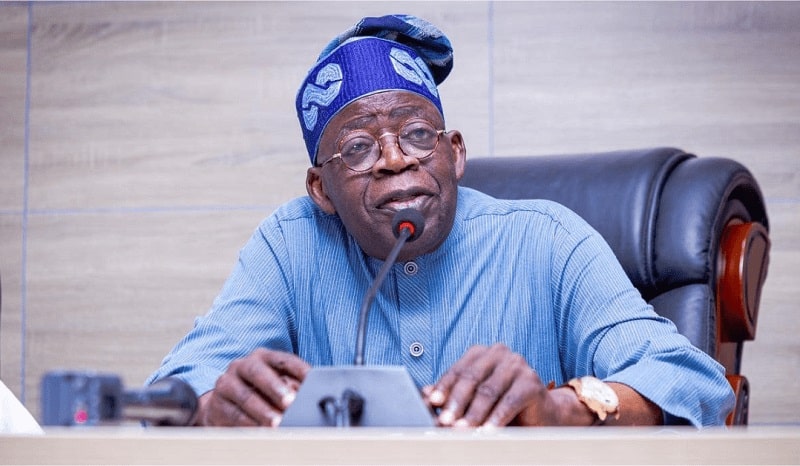
Amend constitution for state police now, Tinubu tells Senate
President Bola Tinubu has requested the National Assembly to begin the process of amending the constitution to incorporate state police as part of efforts to tackle the nation’s security challenges.
The President made the appeal on Wednesday night during an interfaith breaking of fast with members of the Senate at the Presidential Villa, Abuja.
Tinubu, who described Nigeria as “extremely challenged” by terrorism, banditry, and insurgency, said the constitutional amendment had become imperative to enable the country secure its forests from bandits and free children from fear.
“What I am asking for tonight is for you to start thinking how best to amend the constitution to incorporate the state police for us to secure our country, take over our forests from marauders, free our children from fear,” the President stated.
He commended the senators for their unwavering support in addressing security challenges, pledging not to take their collaboration for granted.
“You never fail to make the right response to these calls. All the critical support that I’ve enjoyed, I promise that I will continue to enjoy it and will not take you for granted,” Tinubu said.
The President’s appeal comes barely three days after he made a similar promise to state governors during an Iftar dinner on Monday, where he vowed that the establishment of state police “will not be postponed.”
During that event, Tinubu had declared, “What I promise you is not to be postponed. We will establish state police to combat insecurity.”
The call for state police has gained momentum nationwide, with state governors, traditional rulers, and security experts advocating for its establishment as a solution to Nigeria’s security situation.
Policing in Nigeria is exclusively under federal control, with states depending on the Nigeria Police Force for internal security operations.
However, the centralised structure has been criticised as inadequate to address the diverse and localised nature of security threats across the 36 states.
Establishing state police will require a constitutional amendment, which must pass through both chambers of the National Assembly with a two-thirds majority and be ratified by at least 24 of the 36 state Houses of Assembly.
Proponents argue that state police would enable governors to have direct control over security operations in their states, allowing for quicker response to localised threats and better community policing.
However, critics have raised concerns about potential abuse by governors, politicisation of the police, and the financial implications of maintaining separate police forces across 36 states.
In his speech, President Tinubu also addressed criticisms against his administration, particularly allegations that he is “killing the opposition” through defections of opposition members to the ruling All Progressives Congress.
“What they call you, any name, any nickname, critics must talk. When they accused me of killing opposition, I didn’t have a gun.
“I could have given myself a license when I had the authority, but I can’t blame anybody for jumping out of a sinking ship,” the President stated, referring to recent defections from opposition parties.
He called for unity among political leaders in confronting the nation’s challenges, emphasising that terrorism and banditry require a united front.
“We should pull together, unite in a way that our forefathers contemplated to bring about a constitutional democracy. It’s a good thing that we are working in harmony.
“We are looking for a country that evolves, that takes care of citizens and protects all of us,” Tinubu said.
The President also credited the National Assembly for supporting his administration’s economic reforms, particularly the removal of fuel subsidy and the unification of the foreign exchange market.
“I have a lot of credit for bold reforms. Without your collaboration, without your inspiration, those reforms are not possible. We are reformists together,” he stated.
Defending the subsidy removal, Tinubu described the previous regime as “monumental corruption,” adding that his administration chose not to participate in corrupt practices.
“What we gave up and what we stopped is monumental corruption in subsidies.
“We gave it up. We don’t want to participate in monumental corruption, in arbitrage, or in foreign exchange.
“You don’t have to chase me for dollars like in the past,” the President stated.
He claimed that Nigeria now enjoys economic stability and prosperity, urging senators to be proud of the current moment.
“You could see what Nigeria is today. You should be proud, and I’m glad you are proud of this moment in time.
“What we are enjoying is a stable economy, prosperity beckoning us. We just need to work hard,” Tinubu said.
The President also highlighted the rare convergence of Ramadan and Lent, describing it as a time for reflection, sacrifice, compassion, and national unity.
“The season of reflection, sacrifice, compassion and national unity is reflected by you tonight. And I don’t take it lightly,” he stated.