Tinubu: Nigeria to unlock $30bn in climate change financing annually
President Bola Tinubu says Nigeria has launched a Climate and Green Industrialisation Investment Playbook aimed at unlocking between $25 billion and $30 billion annually in climate finance.
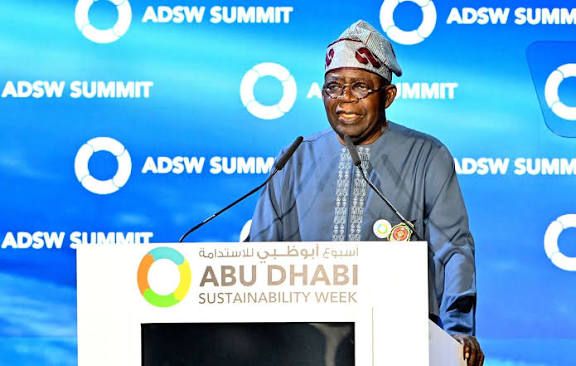
Tinubu spoke on Tuesday at the ongoing Abu Dhabi Sustainability Week (ADSW) in the United Arab Emirates (UAE).
The president said the initiative reflects Nigeria’s resolve to move beyond climate ambitions to concrete delivery, while aligning climate action with energy access, economic growth, job creation and social inclusion.
“The connections between climate and the global economy, health and energy systems, as well as food security must now shape the way we govern and cooperate,” Tinubu said.
“At this defining moment in history, Nigeria stands with the global community in moving beyond ambition and towards delivery.”
He said Nigeria considers climate action a development opportunity rather than a burden, noting that fair climate action requires predictable financing, accessible technology and strong capacity-building support for developing countries.
Tinubu said Nigeria has taken key regulatory steps to strengthen climate governance, including the adoption of the National Carbon Market Activation Policy (NCMAP) and the launch of the National Carbon Registry to improve measurement, reporting and verification systems, as well as investor safeguards.
He said the Electricity Act 2023 has laid the foundation for decentralised and inclusive energy delivery, enabling sustainable power supply to rural communities, off-grid health facilities, schools, markets and underserved populations.
The president said Nigeria is also seeking partnerships to deploy artificial intelligence (AI) to optimise energy efficiency, while promoting technology transfer, innovation and knowledge exchange.
“The Nigeria Sovereign Investment Authority has launched a $500 million Distributed Renewable Energy Fund, while the World Bank is implementing the 750 million dollars DARES programme, which will expand clean electricity access to over 17.5 million people,” he said.
“We are deepening access to green finance. Our Climate Investment Platform targets $500 million for climate-resilient infrastructure, while our National Climate Change Fund aims for a $2 billion capitalisation.
“The 50 billion naira Sovereign Green Bond issued in 2025 attracted 91 billion naira in subscriptions, while the Lagos State Green Bond was oversubscribed by 97.7%.”
Tinubu said Nigeria’s energy transition plan (ETP) integrates energy access, climate mitigation, industrial growth and social development, with a target of achieving net-zero emissions by 2060.
He added that pilot electric mobility projects and national energy efficiency programmes are helping to reduce emissions, lower costs and stimulate green industrial development.
The president also said Nigeria is prioritising critical minerals for the clean energy transition, highlighting the country’s lithium reserves as having strong potential for battery production and energy storage.
“I take this opportunity to invite partnerships that ensure not just extraction of minerals, but local processing and value-addition, thus creating jobs and strengthening industrial capacity at home,” Tinubu said.
“Nigeria is ready for business. This has been demonstrated by the various reforms we have continued to pursue and in their tangible outcomes being reflected in the economy.”