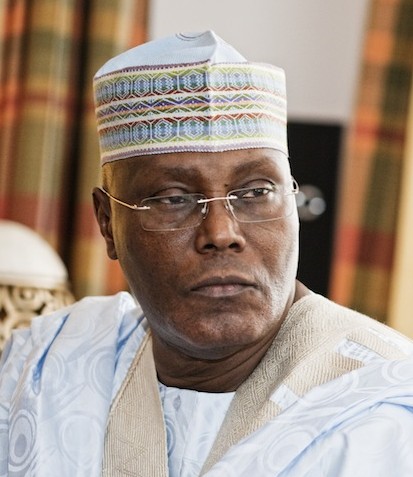
ATIKU MUST EXPLAIN THE LEGAL AND FISCAL BASIS OF HIS PETROL SUBSIDY PROPOSAL
At his press conference in Abuja on Friday, Alhaji Atiku Abubakar reiterated his proposed “production subsidy” for locally refined petrol, which he said would reduce pump prices. He went further to ask President Bola Tinubu to slash the cost of diesel and petrol at the pump.
That proposal raises important legal, fiscal and practical questions that he must answer.
Section 205(1) of the Petroleum Industry Act 2021 provides that unrestricted free-market conditions shall determine wholesale and retail prices of petroleum products. The Nigerian Midstream and Downstream Petroleum Regulatory Authority, in a statement on Saturday, explained that it neither fixes pump prices nor issues administrative price templates, except where the statutory conditions for intervention are met. The PIA provisions guide its function. At the moment, “No such market failure has been declared,” NMPDRA said.
Atiku should therefore explain whether a refinery receiving his proposed subsidy would be required to sell petrol at a prescribed price.
If the answer is yes, he should identify the legal framework under which the government would impose that price condition and explain how it would operate consistently with the Petroleum Industry Act.
If the answer is no, he should explain how public support to refiners would guarantee lower prices at filling stations. Without an enforceable mechanism, refiners could receive the benefit while consumers continued to pay market prices.
Atiku must also disclose the cost of his proposal and how he would fund it.
His earlier statement suggested that the intervention could take the form of preferentially priced crude for domestic refineries. Any discount on crude would reduce the value accruing to the Federation and, consequently, the revenue available to the federal, state and local governments, triggering afresh the fiscal crisis that made 27 states unable to pay salaries and pensions before President Tinubu assumed office in 2023.
Based on publicly reported refinery throughput and domestic petrol-supply figures, the cost of the new subsidy could run as high as N17 or N21 trillion annually, depending on the discount size, the volume covered, and whether the support applies to the entire barrel or only to petrol sold domestically.
These assumptions must be clearly defined. Nigerians deserve to know:
1. the proposed subsidy rate;
2. the annual spending ceiling;
3. the volume of crude or petrol to be covered;
4. the source of funding;
5. the mechanism guaranteeing lower pump prices;
6. the safeguards against diversion, smuggling and fraudulent claims; and
7. whether amendments to the Petroleum Industry Act would be required.
An appropriation by the National Assembly may authorise expenditure, but it would not by itself resolve every regulatory question arising under the Petroleum Industry Act. If Atiku intends to amend the law, he should say so plainly.
His latest position must also be reconciled with his previous support for downstream deregulation. In November 2022 at the Lagos Business School, Atiku described the petrol subsidy system as fraudulent and pledged to complete its removal. He reminded his audience that he chaired the committee that removed its first and second phases, and promised to complete the process. On 25 August 2026, he announced on X, “I will restore it!”
He must explain why he now advocates restoring subsidy in another form and how his proposed arrangement would avoid the abuse, scarcity, smuggling and fiscal losses associated with the old system.
Deregulation of the downstream petroleum sector began under the Obasanjo-Atiku administration. Diesel—which powers food trucks, generators and factories—was deregulated in June 2003. Aviation fuel also moved to market pricing under the same administration. The Buhari administration deregulated kerosene in 2016. Petrol was the last major product retained under the old subsidy regime, which was scheduled to end in June 2023 under the PIA.
Nigeria spent about two decades developing the PIA. The reform process began in 2000, during the first term of the administration in which Atiku served as Vice President. He should therefore explain how his new proposal aligns with the legal and regulatory framework that emerged from that process.
President Tinubu’s administration has instead focused on expanding lower-cost alternatives through compressed natural gas and electric mass transit. These programmes are already reducing transport costs on routes served by CNG and electric buses, while vehicle conversions and supporting infrastructure continue to expand nationwide.
The government has converted more than 120,000 vehicles to CNG, with thousands more converted privately. The administration is working with state governments to extend these savings nationwide.
In his statement on Saturday, President Tinubu recalled the programme he agreed with the governors of the 36 states on August 27:
“From October 1, more Nigerians should begin to see measurable reductions in transportation costs.”
Commuters in seven states and the Federal Capital Territory are already paying between 31 and 83 per cent less on routes served by CNG and electric buses.
In Borno State, the services charge between ₦50 and ₦100 on routes where commercial operators charge between ₦300 and ₦600. Passengers on the Suleja–Abuja service in Niger State pay ₦550 instead of about ₦800. Kaduna’s free CNG buses carried more than 1.4 million passengers in five months of 2025, saving residents an estimated ₦1.39 billion in fares.
Alternative-energy transport in Adamawa State has reduced fares by as much as 50 per cent, while Abia State has deployed 40 electric buses and 20 charging stations.
In contrast, Atiku is reaching into Nigeria’s past with another subsidy scheme that will enrich smugglers in particular. He has yet to tell Nigerians what it will cost or under what law it will operate.
President Tinubu urges Nigerians to ignore politicians who want to drag the country back to the subsidy era. That road leads to mounting debt, petrol queues, payments pocketed by smugglers and cheap Nigerian fuel subsidised for the whole of West Africa.
Nigeria will continue to move forward with a deregulated market that has supported increased investment in domestic refining. The Dangote Petroleum Refinery has reached its nameplate capacity of 650,000 barrels per day and reportedly achieved 700,000 barrels per day during performance tests. The company has also launched an initial public offering targeting ₦2.1 trillion for expansion.
The APC-PCC acknowledges the pressure that higher petrol prices place on Nigerian families. The Tinubu administration will continue to implement policies to support our people. Petrol sold for about ₦830 per litre before the Middle East crisis pushed crude oil prices above $100 per barrel. A de-escalation of the crisis could help reduce crude oil prices and, consequently, the pump prices of petrol and diesel, not just in Nigeria, but worldwide. The NMDPRA is working with the Federal Competition and Consumer Protection Commission against price-gouging and with the Nigeria Customs Service against the diversion of petroleum products across our borders.
The APC-PCC believes that every proposed intervention in the downstream sector must be lawful, transparent, properly costed and capable of delivering measurable benefits to consumers.
Atiku should provide Nigerians with a detailed policy document and an independent legal and fiscal analysis of his proposal. Until he does so, his production-subsidy plan remains an uncosted promise without a clearly identified legal or operational framework.
It will also qualify as one of those fantasies and policy options anchored on what President Olusegun Obasanjo described in his book, My Watch, as Atiku’s “propensity for poor judgment”.
For a start, we recommend that Atiku read the PIA, as he appears out of touch with reality and the oil sector’s current dynamics.
Dele Alake,
Spokesman,
APC Presidential Campaign Council
September 20, 2026