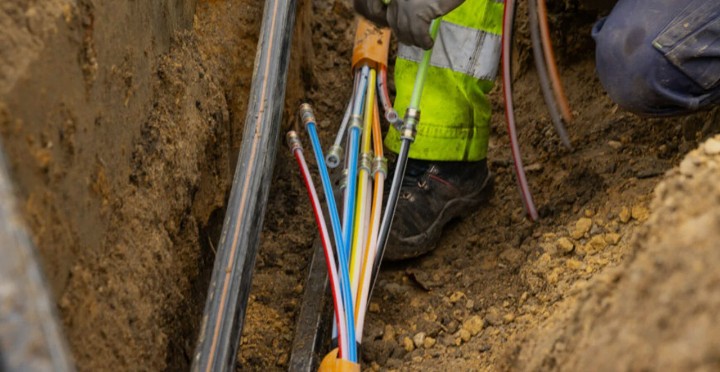
Fibre Cuts: How Communities Pay the Price for Damaged Telecom Infrastructure — Energy Expert
The cost of Nigeria’s recurring fibre cuts is extending beyond telecommunications companies to businesses and communities that depend on digital connectivity for everyday transactions, energy expert and entrepreneur, Dare Osamo, has said.
Osamo, Chief Executive Officer of Impact Energy, said the immediate cost of repairing damaged infrastructure may fall on network operators, but the wider economic burden is ultimately felt by ordinary Nigerians when connectivity is disrupted.
“The common people are the ones that bear the cost the most because the cost is affecting them the most when you can’t use some POS infrastructure and related services, ” he said in an interview on Channels Television’s Business Morning.
His comments come amid continuing concerns over damage to fibre-optic infrastructure, which carries the data supporting a growing range of digital services.
According to Osamo, about 5,000 fibre-cut incidents were reported in the first six months of the year.
Put on an annual basis, he said, the figure could reach about 10,000 incidents, translating to an estimated economic cost of about N70 billion.
“You put that in context, that is about 10,000 per annum, and it comes to about 70 billion in Naira. That is enormous,” he said.
He added that the reported cases amounted to almost 30 incidents daily, excluding cases that are not reported nationwide.
“This is aside costs that are not reported nationwide. So it’s a massive and endemic issue in Nigeria at the moment,” Osamo declared.
The effect of a fibre cut can quickly move from the physical location of damaged infrastructure into the wider community.
When connectivity is disrupted, businesses that depend on digital payments can experience failed POS transactions, while customers may be unable to complete payments or access other network-dependent services. For small businesses and traders, even temporary disruption can mean lost transactions and interruptions to normal operations.
Osamo said this wider impact was why the burden of fibre damage should not be viewed simply as a matter between network operators and those responsible for damaging their infrastructure.
While telecom companies typically bear the immediate cost of restoring damaged cables, he said they may only seek compensation afterwards.
“At the moment, repair costs are being borne by the telecoms company,” he disclosed, explaining “Even if they are going to seek compensation, that is at the back end. One, they need to fix their infrastructure first before seeking compensation for the damages of the installation.”
Osamo identified road construction as the biggest source of fibre damage, saying telecommunications infrastructure and road networks often occupy the same corridors.
“The biggest culprits in this are the road construction,” he revealed, pointing out “Because unfortunately, both the telecom infrastructure and then the road network, they occupy the same space.”
He estimated that almost 90 per cent of fibre cuts were being caused by civil works associated with road construction.
According to him, some roads were constructed decades ago, before the present scale of telecommunications infrastructure was deployed, creating challenges around the mapping and identification of underground cables.
“The current mapping somehow is not sufficient to detect some of this infrastructure,” he said.
However, Osamo said there are mechanisms through which major construction projects can determine whether fibre cables are buried within their work corridors.
“There is a mechanism for major construction to be able to determine if fibre cables are beneath the corridor of work,” he said.
The challenge, he added, is that construction companies need to make the necessary enquiries from telecommunications operators before commencing work.
He called for greater cooperation among telecom operators, construction companies, host communities, artisans, vendors and the general public to reduce damage to fibre infrastructure.
“There is a need for massive education on the side of the community, on the side of the stakeholders,” Osamo said.
He said protecting fibre infrastructure required collective responsibility because the consequences of its disruption extend across the economy.
“The road constructors, the artisans, even the vendors. So everybody must come together to work together in order to protect this asset,” he said.
Osamo stressed that fibre infrastructure should not be regarded as the telecom operator’s asset alone because businesses and communities increasingly depend on it.
“You don’t see it as the operator’s asset alone that is damaging,” he said.
For communities, therefore, the cost of a fibre cut is not limited to the damaged cable or the repair bill. It can show up in a failed POS transaction, a disrupted business operation or a digital service that suddenly becomes inaccessible.
And while the network operator may be the first to pay for restoring the connection, Osamo’s argument is that the wider economic cost is eventually shared by the communities and businesses whose daily activities depend on that connection.