News
Food Security: Abiodun Deepens Ogun’s Agricultural Transformation Drive

Food Security: Abiodun Deepens Ogun’s Agricultural Transformation Drive
By Kayode Akinmade
With support for 10,000 farmers, new mechanisation equipment, digital technology and investments in agro-processing, Governor Dapo Abiodun is pursuing a multi-pronged strategy to boost food production, reduce post-harvest losses and improve farmers’ livelihoods.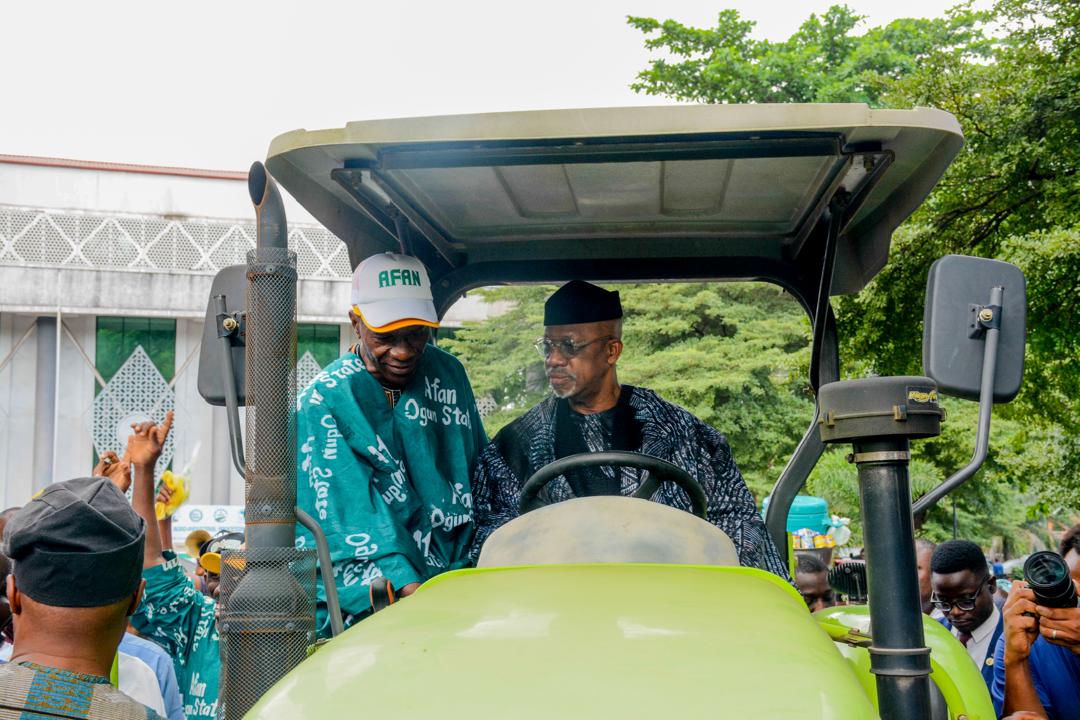

As Nigeria grapples with food affordability and rising agricultural production costs, Ogun State, under Governor Dapo Abiodun, is strengthening efforts to improve food security through targeted support for farmers, mechanisation, digital innovation and investments across the agricultural value chain.
The latest intervention, unveiled at the 2026 World Food Day celebration in Abeokuta, provides a clear indication of this approach. It targets 10,000 rice and cassava farmers with subsidised farm inputs, alongside the distribution of 10 tractors, other agricultural equipment and 1,200 Android phones equipped with applications for weather information, market prices and best agricultural practices.
The initiative reflects an understanding that improving food security requires more than increasing the volume of crops planted. It also demands affordable inputs, timely information, efficient production systems, better storage, processing facilities and reliable access to markets.
For farmers, the cost of fertilisers, herbicides, improved planting materials and machinery can determine whether a farming season produces a profit or deepens existing financial difficulties. By intervening in these areas, the Ogun State Government is seeking to reduce some of the barriers confronting farmers while improving their capacity to respond to market demands.
At the World Food Day event, themed “Innovate Today, Nourish Tomorrow,” Abiodun announced a package of agricultural inputs for 2,000 rice farmers and 8,000 cassava farmers.
Under the arrangement, each beneficiary will receive two bags of fertiliser and one bag of urea. Cassava farmers will also receive 25 bundles of cassava stems each, while the government will provide 10 litres of herbicides to each beneficiary cassava farmer and three litres to each beneficiary rice farmer.
According to the state government, beneficiaries will contribute 30 per cent of the cost of the inputs, depending on the category, while the government will cover the remaining 70 per cent through its partnership with the International Fund for Agricultural Development.
The cost-sharing arrangement is intended to make essential farm inputs more accessible while supporting farmers to increase production. Its ultimate impact will depend on the timely distribution of the inputs, effective monitoring and the extent to which the intervention translates into higher yields and better incomes.
For a state with considerable agricultural potential and proximity to major consumer markets, such interventions carry economic significance beyond the farm. Increased production can support food processing, transportation, wholesale and retail trade, while creating employment opportunities for people who may not be directly engaged in cultivation.
Mechanisation and the Productivity Challenge
One of the longstanding challenges of Nigerian agriculture is the limited access of smallholder farmers to modern equipment. Dependence on manual labour can restrict the size of cultivated land, delay planting and harvesting, and increase production costs.
The distribution of 10 tractors and other agricultural equipment to farm settlements and farmers’ associations is part of Ogun State’s response to this challenge.
Abiodun disclosed that his administration had also procured 39 tractors, four self-propelled harvesters and other agricultural equipment to support mechanisation across the sector.
The importance of mechanisation lies not merely in the number of machines acquired but in the additional land farmers can cultivate, the time saved during critical farming operations and the reduction in losses caused by delays in planting and harvesting.
When appropriately deployed and maintained, tractors and harvesters can help farmers improve operational efficiency and increase production. Shared access through farm settlements and farmers’ associations can also extend the benefits of mechanisation to farmers who cannot afford to purchase equipment individually.
For these investments to deliver sustainable results, however, arrangements for maintenance, spare parts, fuel, operator training and equitable access will be essential.
The objective is to establish a system in which agricultural machinery remains productive, serves a broad base of farmers and contributes to sustained improvements in output.
Digital Technology Comes to the Farm
Another notable feature of the intervention is the distribution of 1,200 Android phones loaded with applications providing weather information, market prices and guidance on good agricultural practices.
The initiative recognises the growing role of information in modern agriculture.
Weather information can help farmers make better decisions about planting and other farm operations, while market-price data can improve their understanding of where and when to sell their produce. Access to agricultural information can also help farmers adopt improved practices and respond more effectively to changing conditions.
For farmers operating in an increasingly unpredictable environment, timely information can influence both productivity and profitability.
The digital initiative is linked to the Ogun State Farmer Information Management System, launched in April 2023 to support agricultural planning and targeted interventions.
Abiodun disclosed that more than 160,000 farmers and agricultural value-chain actors had been captured on the platform.
The database provides a foundation for identifying farmers, understanding their needs and improving the delivery of government support. It can also help the state develop more evidence-based agricultural policies, provided the information is regularly updated and effectively used.
The challenge ahead is to ensure that the technology reaches farmers who need it, that beneficiaries can use the applications effectively and that the information provided is reliable and relevant to local farming conditions.
If these conditions are met, digital technology can become an important tool for bridging information gaps between farmers, agricultural extension services, markets and policymakers.
From Primary Production to Agro-Industrial Development
Beyond the immediate provision of farm inputs and equipment, the Abiodun administration has identified agro-processing as an important component of its agricultural transformation agenda.
The governor disclosed that 28 agricultural projects had been completed in the preceding two years across crop production, aquaculture and poultry.
The projects include solar dryers, warehouses, cassava processing centres and a poultry processing plant at Ajegunle Farm Settlement in Odeda Local Government Area.
According to the governor, the poultry facility has the capacity to process 5,000 birds daily, equivalent to approximately 1.3 million birds annually.
Such facilities are important because agricultural production alone does not guarantee improved incomes for farmers. Where storage and processing infrastructure are inadequate, produce can deteriorate before reaching consumers, while farmers may be forced to sell quickly at unfavourable prices.
Processing facilities can create additional markets for agricultural produce, reduce avoidable losses and support the development of businesses involved in packaging, distribution and food manufacturing.
Cassava processing, for instance, can create opportunities beyond the sale of fresh roots, while poultry processing can improve the handling and distribution of poultry products.
Warehouses and solar dryers can help preserve produce, reduce spoilage and give farmers greater flexibility in deciding when to sell.
The broader economic objective is to retain more value within Ogun State by encouraging agricultural produce to be processed locally rather than sold exclusively in its raw form.
This approach also offers opportunities for industrial investment, especially when farmers can supply processors with consistent quantities and quality of produce.
For Ogun, whose location provides access to major markets, the development of an integrated agricultural value chain could strengthen the relationship between farming, manufacturing, logistics and commerce.
OGSTEP and the Market Connection
The Ogun State Economic Transformation Project (OGSTEP) is another component of the administration’s agricultural development efforts.
Abiodun said agribusiness firms under the programme had purchased more than 283,000 tonnes of agricultural produce, while farmers organised into clusters had received capacity-building support and connections to off-takers.
The emphasis on market access addresses one of the central difficulties confronting farmers: producing crops without having dependable buyers or sufficient information about market conditions.
Connections between farmers and off-takers can help create more predictable demand, while organised clusters can improve coordination, facilitate access to training and inputs, and make it easier for buyers to source produce in commercial quantities.
Where these relationships are sustained, farmers may be better positioned to plan production, negotiate sales and reduce the uncertainty associated with finding markets after harvest.
The reported purchases under OGSTEP also point to the importance of linking agricultural production with commercial demand.
The next stage of the process is to deepen these connections, expand participation and ensure that the benefits of commercial agriculture reach smallholder farmers as well as larger agribusinesses.
Investing in the Next Generation
Agriculture’s capacity to create employment is particularly important in a country with a large population of young people seeking sustainable sources of income.
Yet attracting young Nigerians to farming requires more than encouraging them to cultivate the land. It requires demonstrating that agriculture can support viable businesses through technology, modern production methods, access to finance and dependable markets.
Abiodun disclosed that his administration had partnered with Soilless Farm Lab to train more than 200 young people in soilless farming and provide start-up support to beneficiaries.
Soilless farming offers an alternative production method that can be used in appropriate settings to cultivate selected crops without conventional soil-based cultivation. Depending on the crop, system and operating costs, it can create opportunities for intensive production and specialised agribusiness.
The training initiative represents an effort to expose young people to alternative farming methods and equip them with skills that can support enterprise development.
For such programmes to generate lasting results, training must be accompanied by access to productive resources, business guidance, financing and markets. The long-term measure of success will be the number of viable enterprises established, the jobs created and the extent to which beneficiaries can sustain their operations.
Women also remain central to agricultural production, processing and food distribution. Improving their access to land, inputs, technology, finance and markets can strengthen household incomes and broaden participation in the agricultural economy.
These considerations underline the need for agricultural programmes to combine production support with enterprise development and inclusive economic opportunities.
Land, Investment and Agricultural Expansion
Access to suitable land is another factor that can determine the scale and efficiency of agricultural investment.
The governor said his administration established the Ogun State Agricultural Land Management Agency to facilitate access to land and promote a responsible and inclusive framework for land-intensive agricultural investment.
The agency is intended to address land-access challenges while encouraging investment in commercial agriculture.
At his World Food Day address, Professor Kolawole Adebayo, a former Deputy Vice-Chancellor of the Federal University of Agriculture, Abeokuta, noted that Ogun State had approximately 1.2 million hectares of arable land, representing significant potential for agricultural production and agro-industrial development.
He argued that the state needed forward-looking policies and sustained investment in innovation to realise this potential.
The availability of arable land, however, is only one part of the equation. Agricultural expansion also requires dependable water supplies, suitable roads, storage facilities, access to finance, appropriate technology and a functioning market system.
Adebayo called for an integrated transport network linking rail, road, water and air transport to improve the movement of agricultural produce and preserve its quality before it reaches consumers.
The proposal reflects a broader challenge in food distribution: even when farmers achieve good harvests, poor transportation and inadequate storage can increase costs and reduce the quantity of food that reaches the market in good condition.
Better connectivity between farms, processing centres, warehouses and urban markets could therefore complement investments in production.
For Ogun State, the opportunity lies in linking its agricultural resources with its industrial base, transport connections and proximity to large consumer markets.
Building a More Resilient Food System
The administration’s agricultural initiatives are also part of a wider effort to strengthen the state’s contribution to national food security.
Abiodun commended President Bola Ahmed Tinubu for efforts to strengthen local fertiliser production and improve farmers’ access to agricultural inputs. He also acknowledged the First Lady, Senator Oluremi Tinubu, for initiatives supporting women farmers.
The governor said Ogun would continue to complement federal agricultural interventions through targeted support for farmers, responsible investment and stronger market linkages.
Speaking at the World Food Day celebration, the Commissioner for Agriculture and Food Security, Bolu Owotomo, stressed that access to nutritious and affordable food was fundamental to human dignity and sustainable development.
He called for greater investment in women and young people through improved access to land, finance, training, technology and profitable agricultural opportunities. He also disclosed that more than 12,000 farmers had benefited from training and agricultural inputs under OGSTEP.
The National Programme Coordinator of the Special Agro-Industrial Processing Zones Programme, Dr Kabiru Yusuf, represented by the National Agriculture Expert, Dr Louis Enaberue, commended the state government for its support for agriculture and urged beneficiaries to make effective use of the equipment and inputs provided.
Similarly, the South-West Coordinator of the Commodity Farmers Association of Nigeria, Prince Segun Dasaolu, acknowledged the state’s interventions, while Rotimi Sogunle, speaking on behalf of farm settlers, thanked the governor for supporting farming communities.
Their remarks highlighted the importance of sustained collaboration among government, farmers, development partners, research institutions and private investors.
The Road Ahead
Ogun State’s agricultural strategy combines immediate support for farmers with investments intended to strengthen the wider agricultural economy.
The provision of subsidised inputs can help address production costs. Mechanisation can improve operational efficiency, while digital tools can expand access to information. Processing and storage facilities can create additional markets, reduce post-harvest losses and support value addition. Training and access to land can also open opportunities for new agricultural enterprises.
The ultimate test, however, will be the results these interventions produce over time.
Higher yields, lower production costs, improved farmers’ incomes, reduced post-harvest losses, greater private investment and increased availability of affordable food will provide more concrete measures of progress than the number of projects launched or equipment distributed.
Effective implementation, transparent beneficiary selection, regular monitoring and proper maintenance of public agricultural assets will be critical to sustaining the gains.
Equally important is the need to ensure that smallholder farmers, who constitute a significant part of the agricultural sector, can access the opportunities created by government programmes and private investment.
The 2026 World Food Day intervention places these issues in focus. By combining support for 10,000 rice and cassava farmers with mechanisation, digital technology and investments across the agricultural value chain, the Ogun State Government is seeking to address several constraints on food production simultaneously.
Whether these efforts translate into lasting improvements in food security will depend on their implementation, reach and measurable impact on the people who produce and consume food.
For Ogun State, the challenge is to turn agricultural potential into sustained productivity, profitable enterprises and a more resilient food system—one in which farmers earn better incomes, businesses find opportunities to grow and consumers have improved access to nutritious and affordable food.