
Opinion
From Paris to Abeokuta: How One Signing Capped Seven Years of Ogun’s Investment Push

Published
3 weeks agoon
By
Admin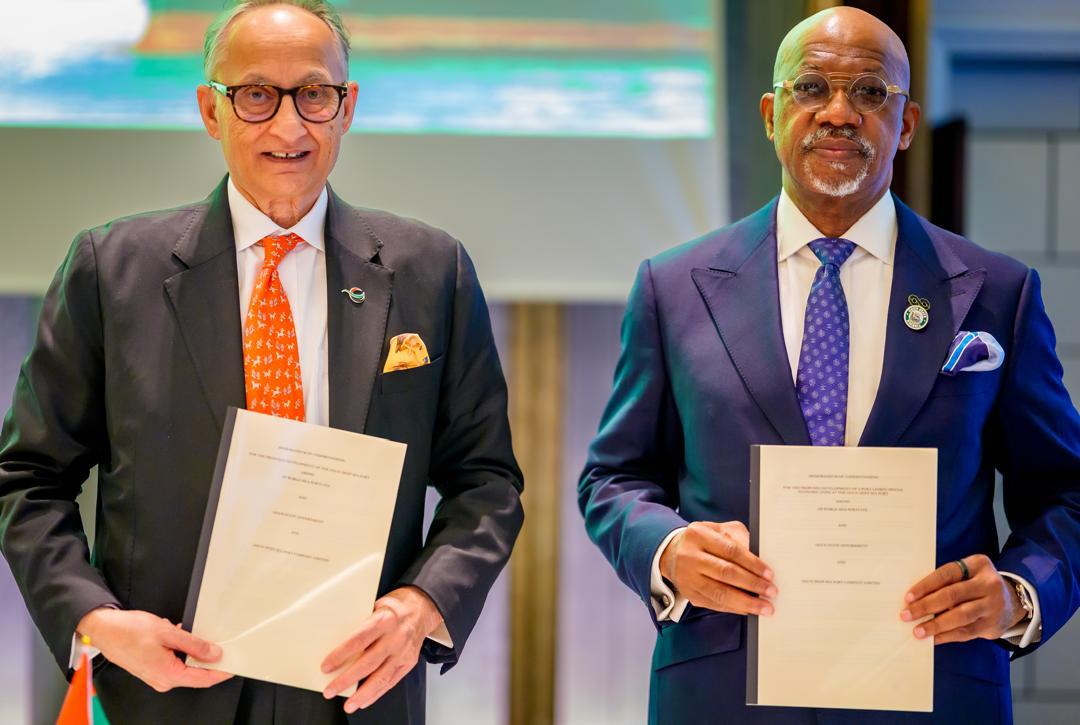
From Paris to Abeokuta: How One Signing Capped Seven Years of Ogun’s Investment Push
By Seyi Bakare
On Thursday in Paris, thousands of kilometres from the Nigerian coastline it is ultimately designed to transform, Governor Dapo Abiodun of Ogun State stood alongside President Bola Ahmed Tinubu and the leadership of DP World as the Ogun State Government and the global ports and logistics giant signed Memoranda of Understanding for the development of the Gateway Deep Seaport and the Ogun State Blue Marine Special Economic Zone.
The agreements envisage more than $7 billion in initial investment and the creation of over 50,000 direct jobs when the projects are fully developed. The proposed Gateway Deep Seaport will feature a four-kilometre berth and an 18-metre draft, while the adjoining Blue Marine Special Economic Zone is designed to create an integrated platform for maritime trade, manufacturing, processing, logistics and exports. (State House)
It was, by any measure, a defining moment for Ogun State.
But the significance of Paris cannot be understood simply by looking at the signatures placed on a document that day. The more important story is the road that led there — roughly seven years of deliberate investment promotion, infrastructure development, institutional reform and strategic positioning that has steadily repositioned Ogun as one of Nigeria’s major investment destinations.
In that sense, the Paris signing was not the beginning of the story. It was the point at which several strands of the story finally converged.
A three-decade ambition moves closer to reality
The vision of a deep-sea port on the Ogun coastline predates the Abiodun administration by decades. What has changed in recent years is the movement of that ambition from a longstanding aspiration towards an increasingly defined investment proposition.
President Tinubu had earlier approved the immediate take-off of the long-delayed project and its development within the framework of the Blue Marine Economic Zone. The coastal strategy has also been accompanied by other federal interventions, including the strengthening of maritime security infrastructure around Ogun Waterside and moves to support the state’s emerging oil and gas potential.
By the time the Ogun Government and DP World signed their agreements in Paris, therefore, the proposed port was no longer being presented as a stand-alone facility. It was becoming part of a broader economic corridor combining maritime trade, industrial production, logistics, energy and transportation.
That distinction matters.
Modern ports increasingly derive their economic power not merely from the ships they receive, but from the industrial and logistics ecosystems that grow around them.
That is precisely the logic behind Ogun’s Blue Marine Special Economic Zone.
What DP World has signed onto
The scale of the proposed development is substantial.
The Gateway Deep Seaport at Ogun Waterside is planned with a four-kilometre berth and an 18-metre draft, specifications intended to enable it to handle large vessels and provide an additional maritime gateway for Nigeria. The Federal Government has positioned the project as part of the response to longstanding congestion and logistics constraints around the Lagos port corridor, particularly Apapa and Tin Can Island. (State House)
But the more transformative component may ultimately be what sits behind the port.
Governor Abiodun has repeatedly framed the Blue Marine Special Economic Zone as an integrated economic platform rather than simply an extension of the seaport. His stated ambition is to replicate, in an Ogun context, the kind of relationship between ports, industrial clusters, logistics infrastructure and export-oriented businesses that has made places such as Dubai’s Jebel Ali economically significant.
The idea is straightforward: cargo should not merely pass through Ogun.
It should generate production, processing, employment, technology transfer, logistics services and exports within Ogun.
That is where the $7 billion proposition becomes more consequential than the headline figure suggests.
A functioning deep-sea port can move containers.
A deep-sea port connected to an industrial and economic zone can help move an economy.
President Tinubu captured this broader logic in Paris when he described the projects as part of an integrated infrastructure ecosystem capable of addressing Nigeria’s logistics constraints and strengthening its position in West African trade. He also linked the development to the wider Lagos-Calabar Coastal Highway, maritime security infrastructure and the state’s emerging energy and gas ambitions. (State House)
How Ogun got here
Thursday’s agreement did not emerge from nowhere.
Since assuming office in May 2019, the Abiodun administration has pursued an investment strategy built around a simple proposition: investors require more than tax incentives and political assurances. They require infrastructure, connectivity, land, institutional support, security and an environment in which their investments can operate efficiently.
One institutional expression of that strategy has been OGUNINVEST, the state’s investment promotion and facilitation agency, established to provide a dedicated platform for attracting and supporting investors.
The approach has been accompanied by an aggressive infrastructure programme.
More than 1,700 kilometres of roads have been constructed or rehabilitated across the state since 2019, while Ogun has continued to consolidate its position as one of Nigeria’s major manufacturing and industrial centres.
The Gateway International Airport has added an aviation component to that investment architecture, while the development of inland dry-port infrastructure is intended to strengthen the state’s logistics chain and improve connections between its industrial clusters and major maritime gateways.
The strategic objective is increasingly clear: build an interconnected network in which roads, airports, dry ports, seaports and industrial clusters reinforce one another rather than function as isolated projects.
That is particularly important for a state whose biggest economic advantage is its location next to Lagos and its existing concentration of industries.
From industrial hub to maritime gateway
Ogun’s investment story has historically been dominated by manufacturing.
Its proximity to Lagos, large industrial estates and expanding road network have helped make it one of Nigeria’s principal manufacturing destinations. The next phase is to connect that productive base more directly to international markets.
That is where the Gateway Deep Seaport assumes strategic importance.
A manufacturer operating in Ogun should, in principle, be able to source raw materials, produce goods, move them through an efficient logistics chain and export them without depending entirely on the already congested Lagos port corridor.
The same infrastructure could serve agricultural processors, petrochemical businesses, construction-material manufacturers, logistics companies and export-oriented industries.
In other words, the port potentially changes the geography of opportunity.
And the economic zone could change the character of that opportunity.
Instead of Ogun merely being the place where factories are located because it is close to Lagos, it can increasingly become a destination where manufacturing, logistics, processing and international trade are integrated around a major maritime gateway.
A growing investment ecosystem
The Paris agreement also comes against the backdrop of Ogun’s broader economic performance.
The 2025 Phillips Consulting State Performance Index placed Ogun second nationally, behind Lagos, in an assessment covering governance, fiscal performance, infrastructure, economic performance, healthcare, education and citizen perceptions. The index combines objective performance indicators with citizen-perception data. (Premium Times Nigeria)
That ranking should not be treated as proof that every challenge has disappeared; the same index contains different dimensions of performance and perception. But it does provide an independent data point on the state’s relative position within Nigeria’s subnational economy.
More importantly, the state’s investment proposition is increasingly being reinforced by physical assets.
The airport, road network, industrial clusters, inland dry-port plans and proposed deep-sea port are beginning to form a connected infrastructure map.
The Blue Marine Special Economic Zone potentially becomes the missing maritime and industrial link in that chain.
The federal-state equation
Another important feature of the Paris agreement is the relationship between the Ogun Government and the Federal Government.
The model being presented is one in which responsibilities are complementary.
The state provides land, local institutional support, investment facilitation and the broader development framework. The Federal Government provides the regulatory, maritime, security and national infrastructure support required to make a project of this scale viable.
President Tinubu explicitly described this collaborative approach at the signing ceremony, stressing the importance of regulatory clarity, policy stability and infrastructure connectivity to long-term investment. (State House)
For Ogun, that federal partnership is particularly significant because a seaport cannot succeed as a state project in isolation.
It requires national highways, maritime regulation, customs infrastructure, security, rail and road connectivity, energy infrastructure and access to international shipping networks.
That is why the presence of the President, the Minister of Marine and Blue Economy, the Nigerian Ports Authority and other key institutions at the Paris signing carries significance beyond ceremony.
From aspiration to implementation
There is, however, an important distinction between signing an MoU and completing a major infrastructure project.
The Paris agreements create a framework and establish an investment pathway. The real test will now be implementation — financing, detailed design, approvals, land and community relations, environmental requirements, supporting infrastructure, construction and ultimately commercial operations.
That is where the next phase of Ogun’s investment story begins.
The state’s challenge will be to convert the credibility generated by the Paris agreements into execution and, eventually, economic output.
If successfully implemented, the Gateway Deep Seaport and Blue Marine Special Economic Zone could do more than add another port to Nigeria’s coastline.
They could provide Ogun with a direct maritime gateway to the African and global economy, deepen the state’s industrial base, strengthen its logistics advantage and create a new corridor for manufacturing, trade, energy and export.
Why Paris matters
The most important thing about Thursday’s signing may therefore not be the photograph of President Tinubu, Governor Abiodun and DP World’s leadership standing behind a signed document.
It is what the document represents.
A three-decade-old ambition has moved closer to implementation.
A state whose investment strategy has largely been built around its proximity to Lagos is positioning itself to become a maritime gateway in its own right.
An industrial economy is seeking a direct connection to global shipping.
And seven years of incremental investment in infrastructure, investor facilitation and economic positioning have converged with federal support and private capital on a project of unprecedented scale for Ogun.
From Paris to Abeokuta, and from Ogun Waterside to the wider Nigerian economy, the real story is therefore not simply about a $7 billion agreement.
It is about whether Ogun can turn infrastructure into industry, industry into exports, and investment into a durable economic transformation.
That is the opportunity now before the state.
And that is why the Paris signing matters.
Bakare sent this piece through [email protected]

