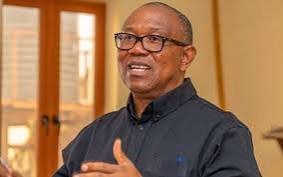
IMPRISONED BY AMBITION : Peter Obi’s reckless misreading of politics and power
By Sunday Dare
If the recent decamping of Peter Obi from the Labour Party to the African Democratic Congress was intended to detonate like a political bombshell, it failed spectacularly. What arrived instead was a dull thud—unremarkable, unsurprising, and terminally familiar. Nothing more. Nothing less. The script had been written long ago, recycled endlessly, and now—ironically—with this latest move, even that script has run out. All smoke. No fire. With his entry into the ADC, the plot does not evolve; it simply ends.
Mr. Obi used the occasion not for clarity or restraint, but to fling predictable broadsides against a man who dwarfs him in political reach, institutional mastery, and historical consequence—Bola Ahmed Tinubu. This is a President who does not govern by tirade, who does not rely on subterfuge, and who does not court cheap populism as a substitute for policy. Mr. Obi would have been better served by silence than by yet another performance dressed up as conviction.
What followed was entirely in character. Mr. Obi once again chose provocation over substance—an incendiary display that substitutes indignation for understanding and accusation for evidence. This is not courage; it is habit. It reflects a deeper pathology in Nigeria’s political discourse: performative outrage, permanent campaigning, and the restless hunt for relevance. Mr. Obi has made a career of all three.
His political trajectory tells the fuller story. From APGA to PDP, from Labour to ADC, Mr. Obi has drifted across parties with the ease of a man unburdened by ideology or loyalty. Political platforms, for him, are conveniences—vehicles to be boarded and abandoned at will. Causes are temporary. Commitments are elastic. There is no enduring belief system anchoring these movements, only ambition in search of the next available ladder.
This inconsistency was evident even in office. As governor, Mr. Obi perfected a style long on moral posturing and short on durable institutional legacy. He spoke the language of prudence, but left behind little that could withstand rigorous scrutiny. His public persona has always leaned on assertion rather than proof, repetition rather than record. That is not reform; it is rhetorical minimalism masquerading as depth.
On national issues, the shallowness becomes even more pronounced. Mr. Obi’s commentary on macroeconomic management, federal structure, security, and public finance routinely betrays a thin grasp of complexity. Hard problems are flattened into slogans; structural constraints are moralized into personal failings. This is not analysis—it is sophistry. Noise without knowledge. Certainty without comprehension.
The 2023 elections exposed these weaknesses brutally. Buoyed by an emotionally charged but politically unserious following, Mr. Obi misread the national climate entirely. He mistook social-media enthusiasm for nationwide structure, online applause for polling-unit presence, and moral grandstanding for electoral arithmetic. Politics, however, is not a vibes-based exercise. It is built on organization, coalition, discipline, and data.
That absence of seriousness was laid bare in court. In a withering moment, the Supreme Court of Nigeria admonished Mr. Obi for failing to even demonstrate a clear understanding of his own vote tally, while simultaneously disputing the official figures released by Independent National Electoral Commission. To challenge an election without facts, without numbers, without preparation, is not principled opposition; it is political irresponsibility elevated to litigation.
Underlying all this is an unmistakable deification of self. Mr. Obi’s rush to the presidency was not grounded in democratic credentials of sufficient weight, nor in a coalition patiently built across Nigeria’s diverse political terrain. It was propelled by an inflated sense of personal virtue—the dangerous illusion that moral self-regard alone qualifies one to govern a complex federation. History is unkind to such delusions.
Nigeria does not need saints auditioning for office. It needs leaders with gravitas, institutional memory, and a disciplined understanding of power—how it is built, negotiated, and responsibly exercised. These qualities are conspicuously absent from Mr. Obi’s record.
If a New Nigeria is indeed possible, it will not be erected on insinuation, half-knowledge, and rhetorical arson. It will be built on competence, respect for institutions, and the discipline to distinguish facts from theatrics. Sadly, these remain in short supply in Mr. Obi’s latest outing.
By contrast, President Tinubu offers focused leadership, measurable outcomes, and time-tested performance forged over decades of political engagement and executive responsibility. Governance is proceeding with intent, not noise.
In that context, the political horizon is no longer murky.
2027 just got clearer.
See you all in 2031.