
News
Yet Another Garland For A Visionary: The Nation Rises As Vanguard Honours Tunji-Ojo

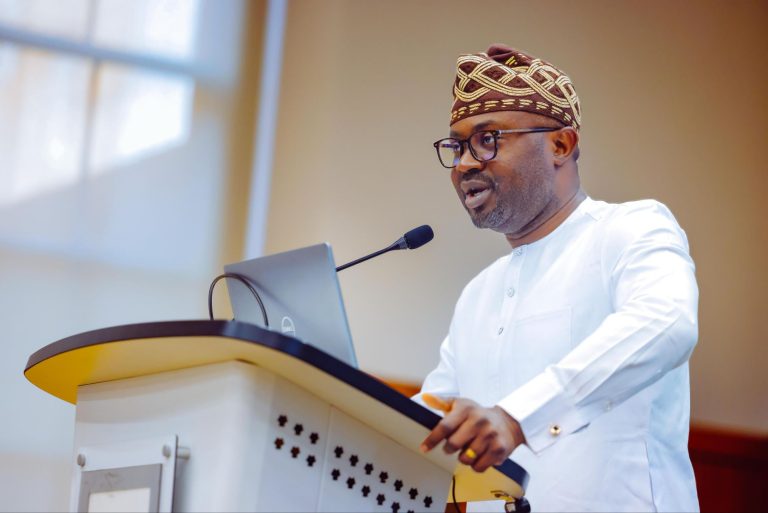
Yet Another Garland For A Visionary: The Nation Rises As Vanguard Honours Tunji-Ojo
There is a particular kind of validation that arrives not with fanfare or surprise, but with the quiet, inevitable weight of proof. When the Vanguard Board of Editors convened for its annual ritual of selecting a Personality of the Year, they did so, as they always do, through fierce debate, rigorous scrutiny, and a determined refusal to be swayed by sentiment. That a sitting minister survived that crucible once was remarkable. That Honourable Dr. Olubunmi Tunji-Ojo has now survived it twice, consecutively, is something else entirely. It is a verdict. It is the editors of one of Nigeria’s most respected newspapers saying, in effect, that in a country starved of functional government, here is a man who is actually governing.
It was not a decision made in comfort. The Vanguard editors have never been known for generosity without evidence. By their own account, the 2025 selection cycle was among the most gruelling in the award’s history, with sessions bleeding into December as nominees were examined, challenged, and in many cases demolished by colleagues armed with facts and institutional memory. Private sector figures arrived in the room with impressive portfolios, only to be undone by skeletons no one had thought to check for. Politicians were proposed and promptly disqualified by the moral weight of their own records. The bar, as it always is in serious editorial rooms, was unforgiving.
And yet, Tunji-Ojo cleared it. Again.
To understand why, one must begin not in the marble corridors of the Ministry of Interior in Abuja, but in the unlikely story of a young man from Akoko, in Ondo State, who was certified as one of Nigeria’s first Certified Ethical Hackers before his twenty-fourth birthday. By that same age, he was already the Chief Executive Officer of Matrix IT Solutions Limited, an indigenous consulting firm whose clients would come to include the Nigerian National Petroleum Corporation, the World Bank, the Joint Admissions and Matriculation Board, and the Ministry of Petroleum Resources. These were not decorative entries on a résumé. They were early signals of a man who understood systems, how they fail, how they are fixed, and how technology could be the bridge between dysfunction and accountability.
He would later deepen that foundation with a master’s degree in Digital Communication and Networking from London Metropolitan University, adding academic rigour to what was already becoming a formidable practical intelligence. Before politics called, he had consulted across oil and gas, agriculture, research, finance, and manufacturing, accumulating more than seventeen years of strategic and project management experience across sectors that most Nigerian officials only claim to understand.
When President Bola Tinubu appointed him Minister of Interior in August 2023, the portfolio that landed on his desk was not a glamorous one. The Ministry of Interior sits at a complicated intersection of internal security, citizenship integrity, immigration management, correctional services, civil defence, and fire safety. It is a ministry that, for much of Nigeria’s post-independence history, has been defined more by its bottlenecks than its breakthroughs. The passport, in particular, had become a national embarrassment, a document so difficult to obtain, so prone to delay, so dependent on unofficial facilitation, that ordinary Nigerians had long since made peace with suffering as the price of citizenship.
Tunji-Ojo decided that was unacceptable. Within months of assuming office, he initiated a comprehensive review of the standard operating procedures across all agencies under his supervision, including the Nigeria Immigration Service, the Nigeria Security and Civil Defence Corps, the Nigerian Correctional Service, and the Federal Fire Service. The review was not cosmetic. It preceded a full automation of the passport and visa acquisition process, creating a system in which applicants could complete their applications from home, without touts, without middlemen, without the degrading uncertainty that had defined the experience for a generation of Nigerians. The Vanguard editors, in naming him joint Personality of the Year for 2025, cited specifically his sustainable approach to the passport challenge, and his continuing digitisation of the ministry’s operations. They were not given to easy praise. The citation meant something.
What often goes unremarked, however, is what he did for the people who work within those agencies. As Chairman of the Civil Defence, Correctional, Fire, and Immigration Services Board, he approved the promotion of 32,361 personnel in 2023 alone, a figure that set an all-time record for the board. By September 2024, that cumulative figure had risen to 53,228. In a country where civil servants routinely spend decades trapped in the same grade, where career stagnation is so normalised it has stopped registering as injustice, those numbers represent something concrete, the kind of change that does not make headlines but reshapes institutions from within, building loyalty, improving morale, and signalling that competence would be rewarded rather than merely endured.
Before the ministry, there was the National Assembly, where Tunji-Ojo served as a member of the House of Representatives representing the Akoko North-East and North-West Federal Constituency. His tenure as Chairman of the House Committee on the Niger Delta Development Commission remains a chapter that his supporters recall with particular pride. The NDDC, long considered one of Nigeria’s most compromised agencies, became the site of what he framed as a serious effort at anti-corruption reform. He also used the position to champion youth inclusion in leadership, a commitment that would become something of a personal signature. Back in his constituency, the work was equally tangible: schools, healthcare centres, and rural road networks, the unglamorous architecture of community development that rarely attracts cameras but consistently earns trust.
None of this is to suggest that Tunji-Ojo is without critics. Nigeria’s political environment ensures that no figure of his prominence escapes scrutiny, and the Interior Ministry, with its vast remit and complex stakeholders, is not a portfolio that lends itself to universal approval. The deeper question the Vanguard award raises is a more interesting one: in a season the editors themselves described as a drought, in a year when the political class was largely distinguished by defections, allegations, and diplomatic negligence, what does it mean that this man stood out? What does it mean that the same rigorous process that rejected a governor for what a colleague called the “increasing ethnicisation of his policies,” that demolished a private sector nominee over sins the editors uncovered in the room, chose him?
It means, at minimum, that results matter. It means that in a system designed to exhaust good intentions, someone found a way to deliver. It means that the passport queue is shorter, that tens of thousands of civil servants went to bed one night with a promotion they had stopped expecting, and that a minister built something that did not exist before he arrived.
For Olubunmi Tunji-Ojo, the award is not a conclusion. It is, by the logic of the man’s own trajectory, more likely a checkpoint. He was a CEO at twenty-four, a legislator who chaired one of the National Assembly’s most scrutinised committees, and is now a minister being celebrated for the second consecutive year by one of the country’s most demanding editorial rooms. The pattern is not of a man who rests on recognition. It is of one who uses it as fuel.
Nigeria, which has never suffered from a shortage of problems to solve, will be watching to see what he does next.
Olubunmi Tunji-Ojo

