
Opinion
BTO in Canada: Celebrating A Reformist Minister As Diaspora Nigerians Look Towards Ondo’s Future

Published
2 months agoon
By
Admin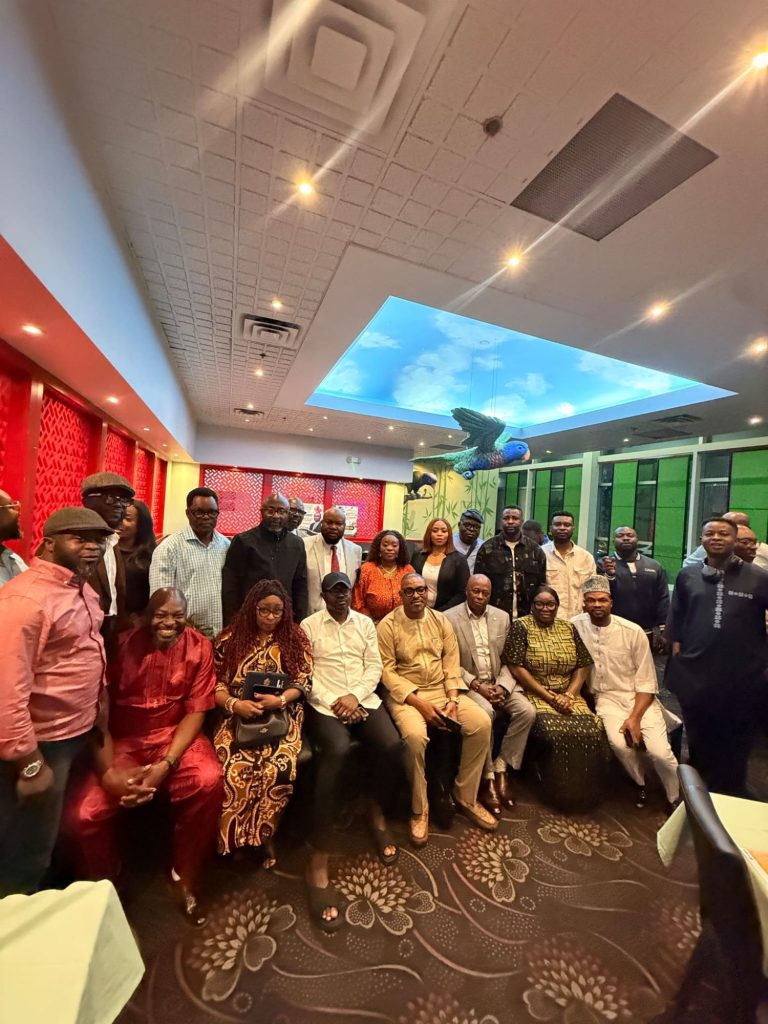
BTO in Canada: Celebrating A Reformist Minister As Diaspora Nigerians Look Towards Ondo’s Future
…From Passport Reforms To Digital Transformation, Tunji-Ojo’s Performance Earns Diaspora Applause
…Ondo Indigenes, Nigerian-Canadians Commend Interior Minister, Urge Him to Consider Governorship Race
By Prince Segun Akanni
Nigeria’s Minister of Interior, Hon. Dr. Olubunmi Tunji-Ojo, popularly known as BTO, may have travelled to Canada principally to participate in the Nigeria Diaspora Economic Conference, but his visit became much more than another official engagement.
It became an opportunity for Nigerians in Canada to assess a public servant whose reform agenda has increasingly attracted attention at home and abroad—and for some Ondo State indigenes in the diaspora to openly raise the question of what his political future might hold.
At the Nigeria Diaspora Economic Conference in downtown Toronto, held at 401 Bay Street from August 12–14, Hon. Tunji-Ojo delivered a presentation that drew warm commendation from participants.
His message reflected a philosophy that has increasingly defined his stewardship at the Federal Ministry of Interior: that public institutions can work better when leadership combines vision, technology, accountability, and the courage to challenge inefficient systems.
But beyond the conference hall, another significant moment awaited him.
A Dinner That Became a Celebration of Performance
Nigerians and Ondo State indigenes resident in Canada hosted the Minister to a dinner reception at Mandarin Restaurant in Brampton.
The gathering, coordinated by Prince Olujimi Adekanle, popularly known as JAF, CEO of Savanah News, alongside other community stakeholders, brought together prominent Nigerian-Canadians, professionals, community leaders, and sons and daughters of Ondo State.
Among those at the reception were Prof. Francis Fasanu, Professor of International Finance and Management Consultant at the School of Business, Sheridan College; Hon. Kelechi “Kaycee” Madu, lawyer and former Minister of Justice and Solicitor General/Attorney General and later Minister of Labour and Immigration, as well as Deputy Premier; and Otunba Femi Salako, a foremost media practitioner and CEO of Triangle Media, among other distinguished personalities.
It was more than a ceremonial reception.
Participants asked questions, offered advice, and engaged the Minister on governance, Nigeria’s development, and the future of Ondo State.
Hon. Tunji-Ojo responded calmly and thoughtfully to the questions put before him, demonstrating the composure that has become an important feature of his public engagements.
Then came one of the most politically significant moments of the evening.
Several participants openly commended his record in public service and urged him to consider offering himself for higher leadership in Ondo State, with calls for him to contest for governor when the time comes.
Rather than being drawn into making a premature political declaration, BTO counselled patience.
His response was measured: there is always a time for everything.
That response may not have settled the political speculation, but it demonstrated an understanding that leadership is not merely about ambition. Timing, responsibility, and circumstances also matter.
Why BTO Is Attracting Attention
The growing interest surrounding Hon. Tunji-Ojo is not occurring in a vacuum.
Since his appointment as Minister of Interior by President Bola Ahmed Tinubu in August 2023, the Ministry has undertaken substantial reforms in areas that directly affect millions of Nigerians, particularly passport administration, immigration services, border management, and digitalisation.
One of the earliest challenges confronting him was the huge backlog of passport applications that had frustrated Nigerians for years.
Under his leadership, the Ministry reported clearing a backlog of more than 204,000 passport applications within weeks.
That was followed by broader reforms intended to move passport administration away from cumbersome processes towards a more efficient, technology-driven system.
For Nigerians in the diaspora, perhaps one of the most consequential initiatives has been the introduction of contactless passport renewal, reducing the need for eligible Nigerians abroad to repeatedly travel long distances and endure cumbersome physical processing.
His Ministry has also overseen the deployment of electronic immigration gates at major international airports, Advanced Passenger Information and Passenger Name Record systems, digital visa processing, and major improvements to Nigeria’s passport-personalisation infrastructure.
A centralised passport personalisation system has also been developed to significantly increase production capacity and improve security and efficiency.
These are reforms that touch ordinary people.
And that distinction matters.
Public service should ultimately be judged not merely by speeches, promises, and ceremonies, but by whether government institutions become easier, faster, safer, and more responsive for citizens.
Technology Meeting Governance
Hon. Tunji-Ojo’s approach to the Interior Ministry is perhaps unsurprising when viewed against his professional background.
Before becoming a major figure in national politics, BTO built a career around engineering, information and communications technology, business, and management.
That technological orientation is now visible in his approach to government.
Instead of treating technology as an accessory to governance, he has repeatedly presented it as an instrument for eliminating bottlenecks, reducing unnecessary human interference, strengthening transparency, and improving national security.
That philosophy can be seen in the digital transformation of immigration processes, passport administration, border surveillance, and identity management.
It is an approach Nigeria desperately needs across its institutions: less dependence on personalities and middlemen, and greater dependence on transparent systems that work.
Reforming the Nigerian Correctional Service
At the Nigerian Correctional Service, his leadership has placed renewed emphasis on decongestion, rehabilitation, accountability, and the transformation of correctional centres from places of mere incarceration into institutions capable of reforming and reintegrating offenders.
The Ministry has reported a reduction in the custodial population from more than 86,000 inmates to about 81,450, partly through interventions involving people who had remained incarcerated for relatively minor and bailable offences.
Perhaps more significantly, Hon. Tunji-Ojo has demonstrated a willingness to confront deeper institutional problems within the correctional system. Following serious allegations of misconduct, corruption, and preferential treatment, he constituted an Independent Investigative Panel to examine the Nigerian Correctional Service and recommend far-reaching reforms.
The exercise went beyond investigating individual cases. It examined dozens of correctional facilities across the country and produced recommendations addressing overcrowding, infrastructure, inmate welfare, healthcare, accountability, rehabilitation, non-custodial alternatives, and the digitalisation of correctional management.
This represents an important shift in philosophy: corrections should not simply punish offenders. They should protect society by rehabilitating individuals and giving them a genuine opportunity for productive reintegration.
Strengthening Civil Defence and Public Safety
The reform drive has also extended to the Nigeria Security and Civil Defence Corps (NSCDC), an important component of the country’s internal-security and public-safety architecture.
Under the broader direction of the Interior Ministry, increasing attention has been placed on strengthening the capacity of agencies under the Ministry, improving coordination, embracing technology, and repositioning internal security around prevention, intelligence, protection of critical national assets, and better institutional performance.
For Hon. Tunji-Ojo, the argument appears straightforward: Nigeria’s internal security cannot depend solely on responding to crises after they occur.
Government institutions must increasingly possess the technology, intelligence, personnel, and coordination necessary to prevent threats, protect communities, and safeguard critical national infrastructure.
Taken together, the reforms in immigration, corrections, civil defence, and other agencies under the Ministry reveal a broader philosophy of governance—one that seeks to replace cumbersome systems with measurable performance, institutional accountability, and technology-driven solutions.
From Akoko to the National Stage:
Hon. Tunji-Ojo’s political rise has itself been remarkable.
The Akoko-born politician represented Akoko North East/Akoko North West Federal Constituency in the House of Representatives, where he served as Chairman of the House Committee on the Niger Delta Development Commission.
He was re-elected in 2023 before being appointed Minister of Interior by President Tinubu.
His transition from ICT professional to federal legislator and subsequently cabinet minister has gradually established him as one of the prominent political figures emerging from Ondo State.
Yet his strongest political asset today may not simply be the offices he has occupied.
It is the perception of performance.
Nigeria has had many brilliant politicians and eloquent public officials.
What citizens increasingly demand, however, are leaders who can translate intelligence, exposure, and political authority into measurable outcomes.
That is the standard against which Tunji-Ojo should ultimately be assessed.
Is Ondo Looking at a New Generation?
The enthusiastic reception in Canada inevitably raises a larger political question.
Could BTO eventually represent a new chapter in the leadership evolution of Ondo State?
Ondo State has produced formidable leaders over the decades, including the late Chief Michael Adekunle Ajasin and Chief Adebayo Adefarati, whose contributions remain part of the state’s political history.
Every generation, however, must produce leaders suited to the challenges of its own time.
Today’s challenges require more than conventional politics. They require technological literacy, economic understanding, institutional competence, global exposure, and an ability to connect government policy with measurable results.
It is within this context that some supporters increasingly see Tunji-Ojo as one of the emerging political leaders capable of carrying forward Ondo State’s tradition of consequential leadership.
Whether he will eventually seek the governorship is, of course, a decision for BTO himself and a matter for another day.
The Minister himself appeared determined not to put the cart before the horse during the Brampton engagement.
That restraint was significant.
Leadership should not always be about campaigning for the next position while occupying the present one.
Sometimes, the strongest campaign for tomorrow is simply performing exceptionally well today.
Performance Before Politics
The Canada reception, therefore, offered something deeper than political endorsements.
It demonstrated that Nigerians abroad are paying attention to developments at home.
Diaspora Nigerians experience government services directly—from passports and visas to immigration and consular processes.
They are, therefore, particularly well positioned to appreciate reforms when those reforms translate into improved service delivery.
Tunji-Ojo’s task now is to consolidate the progress already made.
No ministry is perfect, and significant challenges remain within Nigeria’s immigration, correctional, border-security, and internal-security systems. Reform must, therefore, remain a continuing process rather than a completed assignment.
But where progress occurs, it should be acknowledged.
And where a public official demonstrates capacity, citizens are entitled to ask whether that capacity can someday be deployed on an even broader platform.
That was essentially the message from Brampton.
For the Nigerians and Ondo indigenes who gathered around BTO in Canada, the evening was partly an appreciation of what he has accomplished and partly an expression of hope about what he might still accomplish.
From Akoko to Abuja, and from Nigeria to the warm reception of the diaspora in Canada, Hon. Olubunmi Tunji-Ojo’s public profile continues to rise.
Whether that journey will eventually lead him back home to seek the leadership of Ondo State is a question only time—and BTO himself—can answer.
For now, his response to the calls in Brampton remains instructive: there is a time for everything.
And perhaps that is exactly as it should be. For BTO, the strongest argument for whatever tomorrow may hold is not yet a campaign slogan—it is the record he is building today.
Prince Segun Akanni
Publisher of The Drum Online Organization (Pan-Afrikan) and Convener of the Pan-Afrikan Drum Festival in Canada.
Prince Segun Akanni is the Executive Director, Global Forum for Human Rights and Sustainable Development.
He writes from Brampton, Ontario, Canada.

