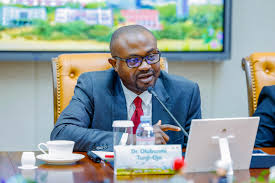
Tunji-Ojo: Redefining public service
I can’t exactly recall who it was that forwarded to me a short video clip of an encounter between Interior Minister, Olubunmi Tunji-Ojo and a station officer in one of Federal Fire Service (FFS) stations in Abuja. In the clip, the minister had stopped by, apparently on an unscheduled visit to know the state of the fire trucks stationed in the premises particularly the state of their readiness in the event of an emergency. An encounter would turn out as much a revelation as it is a testimonial on the state of the nation’s public service: not only was the entire place in deplorable conditions, the few trucks parked in the premise had no water – the official excuse being that the trucks had gone out for operations days before had not had enough time to take in fresh supplies of water!
The account, later put out by the minister would convey not so much his palpable disappointment (which was evident in the brief encounter), but a firm, even barely stated resolve, to clear the mess the same way he had battled the daemons in the service points under his watch:
“Today, I paid an unscheduled visit to the Nigeria Security and Civil Defence Corps (NSCDC) FCT Command and the Federal Fire Service command, Wuse Zone 3 station. The visit helped in the conduct of an on-the-spot assessment of our facilities, and the general preparedness of our gallant officers to address incidents as they can emerge quite unexpectedly. The orders of President Bola Ahmed Tinubu (GCFR) are clear in his yesterday’s national address to the nation where he noted that all hands must be on deck in our collective responsibility to secure this great nation. Security is life, and Mr President is trusting our officers to deliver on the issue of internal security and the protection of critical national assets.
As Minister of Interior, I believe that they will deliver on this, so that we can all be proud of Nigeria, and be able to call this great country a home. More importantly, I will continue to conduct unscheduled on-the-spot assessment of paramilitary commands across the country, as I want to see things the way they are. For me, I want to see the sort of service that Nigerians are getting across all our agencies because like what I always say, a good service is not good enough for Nigerians, but the best, always”.
Minister Tunji-Ojo is right to expect the very best from his front line officials. After all, he is known to have improved the capacity of the agency with the purchase of new equipment, rapid response vehicles, and systems that enhance response time. The story of how the minister has remodelled Federal Fire Service Academy in Abuja is out in the open. But what chance would he have had to turn things around without such surprises designed to keep operatives on their toes?
No doubt, a lot has been written about Nigeria’s Interior Minister, Olubunmi Tunji-Ojo, as one of those bright faces that have delivered not just values to the Bola Tinubu administration, but unparalleled innovations. Talk of redefining the public service in its entirety, Tunji-Ojo, whom his friends call BTO, appears to have captured the imagination of Nigerians as an exemplar of the kind of leadership that Nigeria sorely requires particularly at this time of transition: resourceful (IT-savvy); disciplined and focused – a goal getter. Given that Nigerians are not the easiest to please, it is a measure of the value he represents that Nigerians continue to speak of him in glowing terms.
Here is a minister who moved the mountains where others before him could only skate in circles. Where others saw problems, he thought of them as challenges – and so solvable. Just when successive ministers had sold the passport problem as intractable, he chose to tackle it headlong. First was the issue of the 200, 000 backlog which he inherited. The problem, we were led to believe at the time, was shortage of passport booklets! How the backlog was cleared in a matter of weeks must go on record as the stuff of a genius. There was also the issue of debts said to be to the tune of N28 billion – and this, ironically, for services for which Nigerians are required to pay upfront! This, we now know, have since been retired with Nigerians still wondering about the magic deployed by BTO to clear the mess. With the seamless process currently in place, Nigerians readily testify that the nightmare once associated with passport acquisition is over.
While it is no secret that the minister possesses a background in Information Technology, the marvel is how he has managed to bring the discipline of that technology into virtually every aspect of the job entrusted to him in a public service traditionally known to resist change – and still get fulsome praise for the results!
A good example is the collapse of the 96-odd decentralized personalization centres to a single, secure, centralized and highly efficient passport processing centre, located at the NIS Headquarters in Abuja. That initiative, midwifed by Tunji-Ojo, not only aligns with global best practices but has significantly improved the quality, security, and also reduced the processing and issuance time of Nigerian passports.
His record at the nation’s gateways – the airports – would again attest to the same zeal undergirded by knowledge. Under his watch, some 40 e-gates across the Abuja, Lagos, Kano, Port Harcourt airports have been deployed to facilitate easy passage and maximum comfort. He has equally deployed the “Smart Border Solution” cutting edge technology with the implementation of Smart Border Management and Advanced Passenger Information Systems (APIS). Then is the INTERAS- Electronic Record and Archival Systems, aimed at digitizing records and streamlining operations across various services and agencies, the ECOWAS National Biometric Identity Card (ENBIC) and the new digital platform, Comprehensive Expatriate Residence Permits and Automated Card (CEREAL) application process – the common thread of which is to make service delivery less cumbersome with efficiency and effectiveness as goal.
He has equally paid due attention to the Nigerian Correctional Services. He has ensured the completion of ultra-modern furniture, leather, and shoe factories to afford inmates the opportunity of comprehensive rehabilitation and skills acquisition; the rehabilitation, renovation, and upgrades of some correctional centres across the country has been done. And then, a 4.81 tier petabytes Command and Control centre with 4.1MW battery capacity solar farm which was established to serve the need of Nigeria Correctional Service.
What I consider the most touching of the interventions by the minister is his mobilisation of N585 million from corporate bodies as part of their Corporate Social Responsibility (CSR) initiative to pay the fines of 4,068 inmates serving jail terms for petty offences in various correctional centres across the country. That, to me is a novelty, beyond the call of duty. But then, that is the essence of public service – touching lives in meaningful ways. If only for this, the man they call BTO deserves to be garlanded.
Merry Christmas dear readers.